![Mine workers stumbled upon the smoldering wreckage of a piece of space debris on a dirt road near the town of Newman in the Pilbara region of Western Australia on October 18. [Western Australia Pilbara Police]](/gc8/images/2025/12/15/53066-australia-space-debris-370_237.webp) Mine workers stumbled upon the smoldering wreckage of a piece of space debris on a dirt road near the town of Newman in the Pilbara region of Western Australia on October 18. [Western Australia Pilbara Police]
Mine workers stumbled upon the smoldering wreckage of a piece of space debris on a dirt road near the town of Newman in the Pilbara region of Western Australia on October 18. [Western Australia Pilbara Police] By Kurtis Archer |
Debris from a Chinese Jielong rocket that crashed into Western Australia on October 18 has underscored the risk posed by the uncontrolled reentry of space debris and renewed calls for improved Space Situational Awareness (SSA).
Mine workers stumbled upon the mysterious, smoldering wreckage in the outback near the town of Newman in the Pilbara region of Western Australia, where the burning mass obstructed the access road to an iron ore mine.
The object hit the Earth at 17,500 mph, almost four times the speed of a bullet fired from a gun, according to various media reports, which described it as around five foot across and weighing approximately 660 pounds (300kg).
Flinders University associate professor Alice Gorman was among the experts who identified the wreckage as being from a Chinese rocket -- most likely from a propellant tank made of carbon fiber.
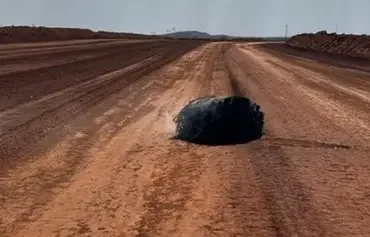 Space debris that hit the Earth around 30km east of the Western Australian town of Newman is seen here in a photo shared on Facebook on October 18 by the Western Australia Pilbara Police.
 ![A still image from the European Space Agency's short documentary film 'Space Debris: Is it a Crisis?' on the state of space debris, which premiered at the 9th European Conference on Space Debris on April 1. [ESA]](/gc8/images/2025/12/15/53062-space-debris-ESA-370_237.webp) A still image from the European Space Agency's short documentary film 'Space Debris: Is it a Crisis?' on the state of space debris, which premiered at the 9th European Conference on Space Debris on April 1. [ESA]
A still image from the European Space Agency's short documentary film 'Space Debris: Is it a Crisis?' on the state of space debris, which premiered at the 9th European Conference on Space Debris on April 1. [ESA]
Solid fuel remains were probably still burning in the tank when the mine workers happened upon the scene, she told The Times of London.
"Rocket bodies are increasingly dangerous bits of debris and, generally, they can’t do a controlled re-entry," Gorman said. "They don’t have communications, they don’t have guidance."
"They’re the most dangerous component of space junk in low Earth orbit, and the most uncontrollable."
The debris is likely to be a composite overwrapped pressure vessel (COPV), according to space analyst Marco Langbroek, who teaches optical SSA at the Delft University of Technology in the Netherlands.
This is a tank inside rockets designed to hold gases and liquids under pressure.
"It reportedly was burning when found, which is unusual and against expectations for space debris," Langbroek wrote in a blog post.
The debris could even be a significant part of the upper stage itself, he noted.
Uncontrolled reentries
Langbroek looked into possible sources of the debris and concluded, along with other experts, that only one potential source was in an orbit that would have passed close to the site where the debris was found on October 18.
This was "the Chinese Jielong 3 stage in a 97.6 degree inclined polar orbit."
In a statement, the Western Australia Police said "initial assessments indicate the item was made of carbon fiber and may be a composite over-wrapped pressure vessel or rocket tank, consistent with aerospace components."
"The object remains under investigation, though its characteristics are consistent with known space re-entry debris," the statement added, noting that further technical assessment would be undertaken by the Australian Space Agency.
China has allowed rocket stages to make uncontrolled reentries into Earth’s atmosphere on a number of occasions.
In August, after the Philippine Coast Guard recovered debris from a Long March rocket near the island of Palawan in the South China Sea, the Philippines condemned China’s rocket activities as endangering its people and property.
In the past five years, the uncontrolled reentry of Chinese space hardware has hit areas near Ivory Coast, the Maldives, and several areas of Southeast Asia.
In November 2022, Spain and other European nations even closed their airspace during the uncontrolled reentry of a Chinese Long March 5B rocket stage.
Ever-increasing risks
The October incident in Australia has drawn renewed attention to the growing problem of space debris and the need for proper space traffic management, amid the ever-increasing risk of collisions.
There have been more objects launched into space in the past three years than in the preceding 65 years, causing serious concern for space debris experts.
The US government currently tracks about 23,000 pieces of debris larger than 10cm.
The European Space Agency (ESA) says the combined mass of all space debris weighs more than 15,100 tons.
The Australian incident highlighted the issue of responsibility, Gorman said, noting that liability for damage or injury that might be caused by falling debris is a murky topic.
"It’s possible that something could land and cause environmental harm," he cautioned. "A lot of rocket propellants are highly toxic, and a lot of rocket materials, or spacecraft materials, are highly toxic as well."
Experts say the solution to potential scenarios like this lies in early-stage debris management, enhanced SSA, and proper traffic management systems.