![The newly operational Paranal solar ESPRESSO Telescope (PoET) is studying the Sun from the European Southern Observatory's Paranal site in Chile. [European Southern Observatory]](/gc8/images/2026/06/01/56153-poet1-370_237.webp) The newly operational Paranal solar ESPRESSO Telescope (PoET) is studying the Sun from the European Southern Observatory's Paranal site in Chile. [European Southern Observatory]
The newly operational Paranal solar ESPRESSO Telescope (PoET) is studying the Sun from the European Southern Observatory's Paranal site in Chile. [European Southern Observatory] By John Fernando Muñoz |
At the summit of Cerro Paranal in northern Chile, the European Southern Observatory operates the Very Large Telescope (VLT), one of the most powerful ground-based observatories humanity has ever built.
Now, another telescope has joined it on the same platform, taking advantage of the observatory's optimal conditions, which in addition to the altitude include the extremely dark and clear skies above the Atacama Desert.
The Paranal solar ESPRESSO Telescope (PoET) completed its test observations, known as "first light," in April.
But unlike its neighbor, which scans the heavens in search of exoplanets and protoplanetary discs, scrutinizes supermassive black holes and studies the formation of stars, PoET has a singular purpose: It looks only at the Sun.
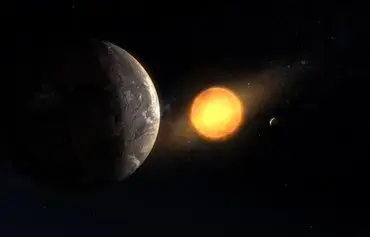 Exoplanet Kepler-1649c was discovered by a team of international scientists analyzing data from NASA's Kepler space telescope. This illustration shows it orbiting around its host red dwarf star. [NASA/Ames Research Center/Daniel Rutter
 ![Monitors display solar spectra data captured by the Paranal solar ESPRESSO Telescope at the European Southern Observatory's Paranal site in Chile. [European Southern Observatory]](/gc8/images/2026/06/01/56154-poet2-370_237.webp) Monitors display solar spectra data captured by the Paranal solar ESPRESSO Telescope at the European Southern Observatory's Paranal site in Chile. [European Southern Observatory]
Monitors display solar spectra data captured by the Paranal solar ESPRESSO Telescope at the European Southern Observatory's Paranal site in Chile. [European Southern Observatory] ![The Paranal solar ESPRESSO Telescope is installed at the European Southern Observatory’s Paranal site in Chile. [European Southern Observatory]](/gc8/images/2026/06/01/56155-poet3-370_237.webp) The Paranal solar ESPRESSO Telescope is installed at the European Southern Observatory’s Paranal site in Chile. [European Southern Observatory]
The Paranal solar ESPRESSO Telescope is installed at the European Southern Observatory’s Paranal site in Chile. [European Southern Observatory]
The new telescope aims to study our nearest star in unprecedented detail in order to learn how to find planets orbiting distant ones, advancing the search for worlds beyond our solar system.
More than 6,000 exoplanets have been confirmed to date, according to NASA.
Most are gas giants, enormous worlds whose gravitational pull on their host stars is strong enough to detect with relative ease.
Yet rocky planets the size of Earth remain stubbornly difficult to detect. A well-worn analogy likens this to trying to spot a mosquito flying next to a blinding stadium searchlight from miles away.
The obstacle is not only their natural darkness and small size. It is the noise.
Cutting through astrophysical 'noise'
Stars are not quiet objects. Their surfaces are in constant upheaval. Dark, cooler patches called sunspots appear and disappear, bright regions known as faculae flare up, and all of this churning distorts the light that reaches us.
That light, split into its component colors to form what astronomers call a spectrum, is the primary tool planet hunters use.
By detecting tiny shifts in a star's spectrum, they can infer that something is tugging gravitationally on it: a planet, perhaps.
But when the star itself is producing fluctuations in its own light, telling the real signal apart from the stellar interference can become nearly impossible.
In an interview with Blueshift, PoET project principal investigator Nuno Santos, of the University of Porto's Institute of Astrophysics and Space Sciences, laid out the problem plainly.
"One of the greatest challenges for the detection of other Earths orbiting other Suns is related to stellar physics, or rather to the astrophysical 'noise' coming from the host stars," he said.
Santos explained that "these phenomena deform and change the position of the spectral lines that we use to derive radial velocities (to search or characterize planets) or to detect the atmospheres of distant worlds."
The central problem has been understood for decades. What has been missing, until now, was the right tool with which to tackle it.
"When we tried to approach this problem a few years ago, we quickly realized that there is no telescope on Earth capable of doing this," Santos said.
What the team needed was an instrument that could capture solar spectra with the same precision, resolution and wavelength range used in exoplanet research.
They needed an instrument that could be aimed at any specific region of the solar disc, from an individual sunspot to a bright facula, and feed that light into a world-class spectrograph.
That combination did not exist anywhere. The solution was to build it.
European Research Council funding
PoET sits behind the Very Large Telescope (VLT) Interferometer Laboratory, connected by optical fibers to ESPRESSO, a spectrograph that ordinarily operates as a VLT instrument after dark.
"ESPRESSO is the top instrument in the field, so the choice was obvious," Santos said. But the engineering challenge was real: no one can point a telescope the size of the VLT at the Sun without catastrophic consequences.
"The solution was, in a way, simple: install a small telescope at Paranal and inject, using optical fibers, the solar light into ESPRESSO."
The result is a 60-centimeter primary mirror telescope designed to observe small areas of the solar disc, paired with a pointing system of smaller refractors that simultaneously collect light from the entire visible solar surface.
Because ESPRESSO can be fed by two fibers at once, it captures both streams at the same time: light from a specific solar feature and light from the full disc, something no ground-based telescope had ever done before.
"We will be able to analyze very specific areas of the Sun, with a very high resolution, in a way never done before," co-principal investigator Alexandre Cabral of the University of Lisbon said in an April 9 ESO statement.
The obvious question now is when this will achieve actual exoplanet discoveries.
Santos, who has been in the field long enough to know that new instruments rarely behave exactly as planned, was measured in his answer.
"At this stage, we are finishing some corrections in the instrument," he told BlueShift. "We are on the edge of starting the acquisition of scientifically meaningful data."
"We do expect the first results in the coming months, but science is always full of surprises, and using a new instrument can sometimes be challenging. So I prefer not to give a date," he said.
International cooperation
PoET is funded by the European Research Council through the FIERCE project (FInding Exo-eaRths: tackling the ChallengEs of stellar activity).
The telescope was designed and built in Portugal, with European Research Council funding, and a team of 12 Portuguese researchers was on-site for the installation and testing of the solar telescope.
The primary mirror was manufactured in Italy. The dome was built by a Chilean company. The project is now operated remotely from the Centre for Astrophysics at the University of Porto.
Once processed through ESPRESSO, the data will be made available to researchers worldwide through the ESO Science Archive Facility.
At its core, PoET represents a deliberate choice to stop looking outward for a moment and turn toward the nearest source of light, on the bet that understanding what is right in front of us is the path to seeing what lies beyond.