![Universal News Reel of the Cape Canaveral launch of the Explorer 1 satellite aboard the Jupiter C rocket from February 1, 1958. [Archive.org/Universal Newsreels]](/gc8/images/2026/04/02/55254-first-us-satellite-370_237.webp) Universal News Reel of the Cape Canaveral launch of the Explorer 1 satellite aboard the Jupiter C rocket from February 1, 1958. [Archive.org/Universal Newsreels]
Universal News Reel of the Cape Canaveral launch of the Explorer 1 satellite aboard the Jupiter C rocket from February 1, 1958. [Archive.org/Universal Newsreels] By Kurtis Archer |
"The day of space travel has almost arrived," American science writer Hal Goodwin writes in "The Real Book About Space Travel," first published in 1952.
More than 70 years later, the book's perceptions, predictions and speculations have proven to be both uncannily accurate and wildly wrong.
How so, you ask? Let's turn back the pages and take a look back at the future, as the scientists of the 1950s envisioned it.
'Birds of space'
Goodwin describes "birds of space" that would act as scouts -- the first artificial satellites. These would be fired into space one at a time, he wrote, starting in the latter half of 1957.
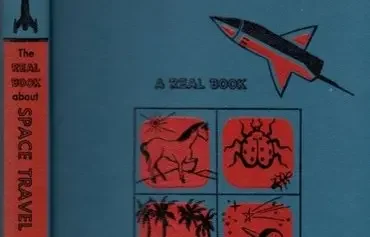 First published in 1952, American science writer Hal Goodwin's "The Real Book About Space Travel" aimed to inform and inspire the readers of the era.
 ![Universal News Reel footage shows the Cape Canaveral launch of the Explorer 1 satellite by the Jupiter C rocket. [Archive.org/Universal Newsreels]](/gc8/images/2026/04/02/55255-satellite-launch-computer-370_237.webp) Universal News Reel footage shows the Cape Canaveral launch of the Explorer 1 satellite by the Jupiter C rocket. [Archive.org/Universal Newsreels]
Universal News Reel footage shows the Cape Canaveral launch of the Explorer 1 satellite by the Jupiter C rocket. [Archive.org/Universal Newsreels] ![The first US satellite, Explorer 1, launches from Cape Canaveral, Florida aboard a Jupiter-C rocket on January 31, 1958. [NASA]](/gc8/images/2026/04/02/55253-launch-explorer-1-370_237.webp) The first US satellite, Explorer 1, launches from Cape Canaveral, Florida aboard a Jupiter-C rocket on January 31, 1958. [NASA]
The first US satellite, Explorer 1, launches from Cape Canaveral, Florida aboard a Jupiter-C rocket on January 31, 1958. [NASA]
"Once they have reached their assigned position in space, they will move into the kind of path called an orbit, and they will circle the earth as artificial moons."
Goodwin credits The International Geophysical Year (July 1957 to December 1958) as the reason such ambitious satellite projects were being prioritized.
That year, which saw the Soviet Union and the United States launch their first satellites, marked a resumption of scientific interchange between East and West after a long period of interruption and restriction that began during World War II.
Goodwin’s timeframe was accurate -- Sputnik 1 entered outer space in October 1957 -- though he had anticipated that the United States would be the first. The US Army successfully launched Explorer 1 into space in January 1958.
"No matter what nation wins the race to hang a man-made moon in the sky, America already has the credit for first crossing the space frontier," he says of the flight of the first operational sounding rocket developed in the US.
WAC Corporal was a 16-foot, liquid-fueled rocket launched by a "Tiny Tim" booster that first reached space in 1946.
Goodwin accurately predicts that satellite drag will cause satellites to burn up in the atmosphere upon reentry one day. He describes an observational satellite system not unlike Google Earth, and a broadcasting system not unlike Starlink.
As for Earth's natural satellite, the moon, Goodwin notes that a Russian magazine had predicted the Soviet flag would be planted on the lunar surface within 50 years.
The United States succeeded in planting its own flag on the moon by the end of the following decade, but the Russians have still not done so to this day.
'The sky hook we need'
Goodwin correctly predicts that intercontinental ballistic missiles (ICBMs) will likely be the technology that allows humans to cross the barrier into space.
He inaccurately predicts that a space station or platform will be the "sky hook we need" to be the jump-off point for spaceships to go to the moon and other planets, though this technology may be used for this purpose someday.
He accurately predicts that the first piloted rocket will launch after experiments with unmanned orbital rockets. "Probably it will be a three-step rocket, but it could have four or five steps."
Goodwin inaccurately predicts that humans would build a space station before visiting the moon, and that the first visit to the moon will be a slingshot around it without landing. Though he was correct about the lack of a lander, Apollo 8 orbited the moon 10 times before returning to Earth using its own engine.
He even describes how SpaceX rockets land today: "Another method of landing would be to turn the ship end for end and land on the stern jets. The rocket in the excellent motion picture Destination Moon used this method. It would work, but it would use lots of fuel and it would be dangerous. A miscalculation could mean disaster."
"Probably not too long after the first space station is orbiting around earth there will be a moon station," he predicts -- a wise hypothesis, considering that NASA and partners are currently planning a moon base.
Blizzards on the moon
Goodwin says shooting stars, and even blizzards, have been seen on the moon. One of the observers was Professor W. H. Pickering, he writes, who said he saw both blizzards and snowstorms on the lunar surface.
Scientists today understand these observations were not of atmospheric weather but of optical changes and bright mineral deposits that shifted in appearance based on the Sun’s angle.
"There have been lucky observers who have seen faint dawns and sunsets on the moon," Goodwin writes. "There can be no dawn or sunset without air."
Scientists now know these "lunar sunsets" are a phenomenon created by dust particles creating a glow effect, but at the time of the book’s publication experts did not know if air existed on the moon.
Many experts also believed that the moon may have had plants and volcanic activities. Pickering even thought strange shadows observed on the moon might be swarms of lunar insects.
At the time of the book’s printing, lunar experts disagreed on whether the moon had an atmosphere, water and life.
'A billion light years!'
Goodwin reports that the 200-inch Hale Telescope on Mount Palomar in San Diego County, California "can see into space for a billion light years!"
Modern telescopes such as NASA's James Webb Space Telescope (JWST) can see objects that are about 33.8 billion light-years away.
"The wide-angle Schmidt telescope, which is really a magnificent camera, is photographing the heavens systematically," he writes. "When these photographs are assembled they will form the first complete celestial atlas ever issued of the universe as seen from the Northern Hemisphere.
"The National Geographic Society expects the atlas to be ready in 10 years."
This first complete and high-quality photographic celestial atlas was finished in 1958, ahead of the schedule described in the book.
'The pay load may be men'
Goodwin defines "thrust" and "pay load" for readers of the 1950s -- terms that are still used today. He uses "no-weight" as much as he uses "zero-gravity" – the former term losing out to the latter in popular culture.
"Space junk" is also a term used in the book -- but it refers to comets, meteors, and asteroids as opposed to today’s "space junk," which refers to orbital debris.
Experts in the 1950s correctly believed zero-gravity would be something human bodies can get used to, and that it would be relatively harmless for human biology in short periods.
They did not know if zero-gravity would be harmful over weeks or months, something today’s experts have learned more about due to crewed missions on the International Space Station. Goodwin mentions that X-rays and cosmic rays would be dangerous to men in space -- something scientists now know is true.
"When we send the first rocket into outer space, perhaps to the moon, the pay load may be instruments. It may be a charge which we could see through telescopes when it went off on the moon. Or the pay load may be men."
Goodwin mentions the "spinning wheel spaceship" design many scientists have spoken about over the years.
He surmises that future spaceships might have magnetic seats and floors, with metal woven into astronaut clothing to pull them down and simulate gravity.
He predicts specifications and difficulties in making human spacesuits for extraterrestrial travel, and points to a then-new wristwatch battery announced in 1952 as a possible way that many tools in space might be powered.
'Moon wheel'
Goodwin gets into the physics of spaceflight, explaining how centrifugal force acts against gravitational pull, offering a real-world example appropriate for the time.
"Take a rubber ball which is connected to a long elastic string. Such balls, with elastic strings already attached, often can be found at novelty stores."
He defines "escape velocity" as the speed needed to get free of the planet, citing 7.1 miles per second or 25,560 mph as necessary. These figures are slightly higher than what we now know to be true, but offer a fairly accurate prediction.
Goodwin critiques the idea of a "moon train" being shot from a giant cannon to Earth’s natural satellite, an idea Jules Verne wrote about. He also mentions the idea of a "moon wheel" that was supposed to be six miles in diameter.
"A giant wheel, several miles in diameter, was to be built with its axle tips resting on two mountain tops. The wheel would be spun very rapidly until a car, attached to the rim, could be released and thrown at the moon."
Humans have neglected to build such a system thus far, perhaps for obvious reasons.
'Interplanetary ski jump'
Goodwin mentions cannons and wheels being suggested in other ways, too.
He references the November 1931 issue of the Bulletin of the American Interplanetary Society: "They were mentioned as possibilities for giving a rocket a first big shove towards space before the rocket motors were turned on."
"Another suggestion in the same bulletin was a sort of interplanetary ski jump. The rocket was to be placed on a huge carriage, like a railroad flatcar, which would roll down a mountainside.
The car would be powered like an automobile and would reach perhaps 1,000 miles an hour. The track would gradually curve upward, then stop.
As the rocket approached the end of the track it would fire its jets and take off, adding its own thrust to the speed of the ski jump ride. A similar idea was used in a motion picture, When Worlds Collide."
The author seemed very much aware of how outlandish some of the suggested methods were.
"All these ideas, none of which was very practical, were directed toward one big job -- that of getting up enough velocity for a space ship to break away from earth's gravity."
Goodwin describes how a motorcycle being carried on an automobile which is going up a cliff could leave the automobile as soon as it starts to lose speed, allowing the motorcycle already going at the automobile’s speed to add its own additional speed. This description is precisely how a multi-stage rocket works.
He accurately predicts that "step rockets" are how humans will eventually travel into space, and that humans making a round-trip to the moon is "years away."
UFOs and alien life
The book curiously approaches its conclusion with a pivot into ufology.
It notes there have been two centuries of UFO records, and that a legitimate case exists for the possible existence of "interplanetary saucers" and unearthly cigar-shaped craft.
Goodwin references an April 7, 1952 Life Magazine article on the topic, and suggests that aliens may be watching the development of human technology with great interest.
"But this is all guesswork. We don't really know. We don't really know that the flying saucers are space ships. However, only the alien space ship theory so far gives a logical answer to the behavior of objects which very definitely have been seen, measured and tracked on instruments and by airplanes."
"Space travel. Interplanetary flight. Interstellar flight. Intergalactic flight." Goodwin writes in the early 1950s.
"These are dreams, but at least space travel and interplanetary flight are dreams that can come true. For the others, flight to the stars and other galaxies, we'll just have to wait and see what the years bring."
Despite all the changes, space experts 70 years ago and 70 years from now would agree with Goodwin in a number of ways, but most particularly in his assertion that "space travel is not for those who fear hard work or great danger."
Ref: Goodwin, H. (1956). The real book about space travel (H. Hoke, Ed.). Garden City Books.